
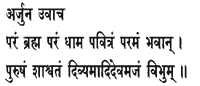
Arjuna said: Thou art the supreme Brahman, the supreme Abode, the supreme Purity, the one permanent, the divine Purusha, the original Godhead, the Unborn, the all-pervading Lord.
The Way and the Bhakta
Sri Aurobindo
IN THE eleventh chapter of the Gita the original object of the teaching has been achieved and brought up to a certain completeness. The command to divine action done for the sake of the world and in union with the Spirit who dwells in it and in all its creatures and in whom all its working takes place, has been given and accepted by the Vibhuti. The disciple has been led away from the old poise of the normal man and the standards, motives, outlook, egoistic consciousness of his ignorance, away from all that had finally failed him in the hour of his spiritual crisis. The very action which on that standing he had rejected, the terrible function, the appalling labour, he has now been brought to admit and accept on a new inner basis. A reconciling greater knowledge, a diviner consciousness, a high impersonal motive, a spiritual standard of oneness with the will of the Divine acting on the world from the fountain light and with the motive power of the spiritual nature,—this is the new inner principle of works which is to transform the old ignorant action. A knowledge which embraces oneness with the Divine and arrives through the Divine at conscious oneness with all things and beings, a will emptied of egoism and acting only by the command and as an instrumentation of the secret Master of works, a divine love whose one aspiration is towards a close intimacy with the supreme Soul of all existence, accomplished by the unity of these three perfected powers an inner all-comprehending unity with the transcendent and universal Spirit and Nature and all creatures are the foundation offered for his activities to the liberated man. For from that foundation the soul in him can suffer the instrumental nature to act in safety; he is lifted above all cause of stumbling, delivered from egoism and its limitations, rescued from all fear of sin and evil and consequence, exalted out of that bondage to the outward nature and the limited action which is the knot of the Ignorance. He can act in the power of the Light, no longer in twilight or darkness, and a divine sanction upholds every step of his conduct. The difficulty which had been raised by the antinomy between the freedom of the Spirit and the bondage of the soul in Nature, has been solved by a luminous reconciliation of Spirit with Nature. That antinomy exists for the mind in the ignorance; it ceases to exist for the spirit in its knowledge. But there is something more to be said in order to bring out all the meaning of the great spiritual change. The twelfth chapter leads up to this remaining knowledge and the last six that follow develop it to a grand final conclusion. This thing that remains still to be said turns upon the difference between the current Vedantic view of spiritual liberation and the larger comprehensive freedom which the teaching of the Gita opens to the spirit. There is now a pointed return to that difference. The current Vedantic way led through the door of an austere and exclusive knowledge. The Yoga, the oneness which it recognised as the means and the absorbing essence of the spiritual release, was a Yoga of pure knowledge and a still oneness with a supreme Immutable, an absolute Indefinable,—the unmanifested Brahman, infinite, silent, intangible, aloof, far above all this universe of relations. In the way proposed by the Gita knowledge is indeed the indispensable foundation, but an integral knowledge. Impersonal integral works are the first indispensable means; but a deep and large love and adoration, to which a relationless Unmanifest, an aloof and immovable Brahman can return no answer, since these things ask for a relation and an intimate personal closeness, are the strongest and highest power for release and spiritual perfection and the immortal Ananda. The Godhead with whom the soul of man has to enter into this closest oneness, is indeed in his supreme status a transcendent Unthinkable too great for any manifestation, Parabrahman; but he is at the same time the living supreme Soul of all things. He is the supreme Lord, the Master of works and universal nature. He at once exceeds and inhabits as its self the soul and mind and body of the creature. He is Purushottama, Parameshwara and Paramatman and in all these equal aspects the same single and eternal Godhead. It is an awakening to this integral reconciling knowledge that is the wide gate to the utter release of the soul and an unimaginable perfection of the nature. It is this Godhead in the unity of all his aspects to whom our works and our adoration and our knowledge have to be directed as a constant inner sacrifice. It is this supreme soul, Purushottama, transcendent of the universe, but also its containing spirit, inhabitant and possessor, even as it is mightily figured in the vision of Kurukshetra, into whom the liberated spirit has to enter once it has reached to the vision and knowledge of him in all the principles and powers of his existence, once it is able to grasp and enjoy his multitudinous oneness, j ˜ n¯atu ˙ m dras.t. u ˙ m tattvena praves.t. um˙ ca. The liberation of the Gita is not a self-oblivious abolition of the soul’s personal being in the absorption of the One, s ¯ayujya mukti; it is all kinds of union at once. There is an entire unification with the supreme Godhead in essence of being and intimacy of consciousness and identity of bliss, s ¯ayujya,—for one object of this Yoga is to become Brahman, brahmabhu¯ ta. There is an eternal ecstatic dwelling in the highest existence of the Supreme, s ¯alokya,—for it is said, “Thou shalt dwell in me,” nivasis.yasi mayyeva. There is an eternal love and adoration in a uniting nearness, there is an embrace of the liberated spirit by its divine Lover and the enveloping Self of its infinitudes, s ¯am¯ıpya. There is an identity of the soul’s liberated nature with the divine nature, s ¯adr. ´syamukti,—for the perfection of the free spirit is to become even as the Divine, madbh¯avam ¯agatah. , and to be one with him in the law of its being and the law of its works and nature, s ¯adharmyam ¯agatah. . The orthodox Yoga of knowledge aims at a fathomless immergence in the one infinite existence, s ¯ayujya; it looks upon that alone as the entire liberation. The Yoga of adoration envisages an eternal habitation or nearness as the greater release, s ¯alokya, s ¯am¯ıpya. The Yoga of works leads to oneness in power of being and nature, s ¯adr. ´sya. But the Gita envelops them all in its catholic integrality and fuses them all into one greatest and richest divine freedom and perfection. Arjuna is made to raise the question of this difference. It must be remembered that the distinction between the impersonal immutable Akshara Purusha and the supreme Soul that is at once impersonality and divine Person and much more than either—that this capital distinction implied in the later chapters and in the divine “I” of which Krishna has constantly spoken, aham, m¯am, has as yet not been quite expressly and definitely drawn. We have been throughout anticipating it in order to understand from the beginning the full significance of the Gita’s message and not have to go back again, as we would otherwise be obliged, over the same ground newly seen and prospected in the light of this greater truth. Arjuna has been enjoined first to sink his separate personality in the calm impersonality of the one eternal and immutable self, a teaching which agreed well with his previous notions and offered no difficulties. But now he is confronted with the vision of this greatest transcendent, this widest universal Godhead and commanded to seek oneness with him by knowledge and works and adoration. Therefore he asks the better to have a doubt cleared which might otherwise have arisen, “Those devotees who thus by a constant union seek after thee, tv ¯am, and those who seek after the unmanifest Immutable, which of these have the greater knowledge of Yoga?” This recalls the distinction made in the beginning by such phrases as “in the self, then in me,” ¯atmani atho mayi: Arjuna points the distinction, tv ¯am, aks.aram avyaktam. Thou, he says in substance, art the supreme Source and Origin of all beings, a Presence immanent in all things, a Power pervading the universe with thy forms, a Person manifest in thy Vibhutis, manifest in creatures, manifest in Nature, seated as the Lord of works in the world and in our hearts by thy mighty world-Yoga. As such I have to know, adore, unite myself with thee in all my being, consciousness, thoughts, feelings and actions, satatayukta. But what then of this Immutable who never manifests, never puts on any form, stands back and apart from all action, enters into no relation with the universe or with anything in it, is eternally silent and one and impersonal and immobile? This eternal Self is the greater Principle according to all current notions and the Godhead in the manifestation is an inferior figure: the unmanifest and not the manifest is the eternal Spirit. How then does the union which admits the manifestation, admits the lesser thing, come yet to be the greater Yoga-knowledge? To this question Krishna replies with an emphatic decisiveness. “Those who found their mind in Me and by constant union, possessed of a supreme faith, seek after Me, I hold to be the most perfectly in union of Yoga.” The supreme faith is that which sees God in all and to its eye the manifestation and the non-manifestation are one Godhead. The perfect union is that which meets the Divine at every moment, in every action and with all the integrality of the nature. But those also who seek by a hard ascent after the indefinable unmanifest Immutable alone, arrive, says the Godhead, to Me. For they are not mistaken in their aim, but they follow a more difficult and a less complete and perfect path. At the easiest, to reach the unmanifest Absolute they have to climb through the manifest Immutable here. This manifest Immutable is my own all-pervading impersonality and silence; vast, unthinkable, immobile, constant, omnipresent, it supports the action of personality but does not share in it. It offers no hold to the mind; it can only be gained by a motionless spiritual impersonality and silence and those who follow after it alone have to restrain altogether and even draw in completely the action of the mind and senses. But still by the equality of their understanding and by their seeing of one self in all things and by their tranquil benignancy of silent will for the good of all existences they too meet me in all objects and creatures. No less than those who unite themselves with the Divine in all ways of their existence, sarva-bh¯avena, and enter largely and fully into the unthinkable living fountainhead of universal things, divyam˙ purus.am acintya-ru¯pam, these seekers too who climb through this more difficult exclusive oneness towards a relationless unmanifest Absolute find in the end the same Eternal. But this is a less direct and more arduous way; it is not the full and natural movement of the spiritualised human nature. And it must not be thought that because it is more arduous, therefore it is a higher and more effective process. The easier way of the Gita leads more rapidly, naturally and normally to the same absolute liberation. For its acceptance of the divine Person does not imply any attachment to the mental and sensuous limitations of embodied Nature. On the contrary it brings a swift and effectual unchaining from the phenomenal bondage of death and birth. The Yogin of exclusive knowledge imposes on himself a painful struggle with the manifold demands of his nature; he denies them even their highest satisfaction and cuts away from him even the upward impulses of his spirit whenever they imply relations or fall short of a negating absolute. The living way of the Gita on the contrary finds out the most intense upward trend of all our being and by turning it Godwards uses knowledge, will, feeling and the instinct for perfection as so many puissant wings of a mounting liberation. The unmanifest Brahman in its indefinable unity is a thing to which embodied souls can only arrive and that hardly by a constant mortification, a suffering of all the repressed members, a stern difficulty and anguish of the nature, duh.kham av¯apyate, kle´so ’dhikataras tes. ¯am. The indefinable Oneness accepts all that climb to it, but offers no help of relation and gives no foothold to the climber. All has to be done by a severe austerity and a stern and lonely individual effort. How different is it for those who seek after the Purushottama in the way of the Gita! When they meditate on him with a Yoga which sees none else, because it sees all to be Vasudeva, he meets them at every point, in every movement, at all times, with innumerable forms and faces, holds up the lamp of knowledge within and floods with its divine and happy lustre the whole of existence. Illumined, they discern the supreme Spirit in every form and face, arrive at once through all Nature to the Lord of Nature, arrive through all beings to the Soul of all being, arrive through themselves to the Self of all that they are; incontinently they break through a hundred opening issues at once into that from which everything has its origin. The other method of a difficult relationless stillness tries to get away from all action even though that is impossible to embodied creatures. Here the actions are all given up to the supremeMaster of action and he as the supremeWill meets the will of sacrifice, takes from it its burden and assumes to himself the charge of the works of the divineNature in us. And when too in the high passion of love the devotee of the Lover and Friend of man and of all creatures casts upon him all his heart of consciousness and yearning of delight, then swiftly the Supreme comes to him as the saviour and deliverer and exalts him by a happy embrace of his mind and heart and body out of the waves of the sea of death in this mortal nature into the secure bosom of the Eternal. This then is the swiftest, largest and greatest way. On me, says the Godhead to the soul of man, repose all thy mind and lodge all thy understanding in me: I will lift them up bathed in the supernal blaze of the divine love and will and knowledge to myself from whom these things flow. Doubt not that thou shalt dwell in me above this mortal existence. The chain of the limiting earthly nature cannot hold the immortal spirit exalted by the passion, the power and the light of the eternal love, will and knowledge. No doubt, on this way too there are difficulties; for there is the lower nature with its fierce or dull downward gravitation which resists and battles against the motion of ascent and clogs the wings of the exaltation and the upward rapture. The divine consciousness even when it has been found at first in a wonder of great moments or in calm and splendid durations, cannot at once be altogether held or called back at will; there is felt often an inability to keep the personal consciousness fixed steadily in the Divine; there are nights of long exile from the Light, there are hours or moments of revolt, doubt or failure. But still by the practice of union and by constant repetition of the experience, that highest spirit grows upon the being and takes permanent possession of the nature. Is this also found too difficult because of the power and persistence of the outwardgoing movement of the mind? Then the way is simple, to do all actions for the sake of the Lord of the action, so that every outward-going movement of the mind shall be associated with the inner spiritual truth of the being and called back even in the very movement to the eternal reality and connected with its source. Then the presence of the Purushottama will grow upon the natural man till he is filled with it and becomes a godhead and a spirit; all life will become a constant remembering of God and perfection too will grow and the unity of the whole existence of the human soul with the supreme Existence. But it may be that even this constant remembering of God and lifting up of our works to him is felt to be beyond the power of the limited mind, because in its forgetfulness it turns to the act and its outward object and will not remember to look within and lay our every movement on the divine altar of the Spirit. Then the way is to control the lower self in the act and do works without desire of the fruit. All fruit has to be renounced, to be given up to the Power that directs the work, and yet the work has to be done that is imposed by It on the nature. For by this means the obstacle steadily diminishes and easily disappears; the mind is left free to remember the Lord and to fix itself in the liberty of the divine consciousness. And here the Gita gives an ascending scale of potencies and assigns the palm of excellence to this Yoga of desireless action. Abhy¯asa, practice of a method, repetition of an effort and experience is a great and powerful thing; but better than this is knowledge, the successful and luminous turning of the thought to the Truth behind things. This thought-knowledge too is excelled by a silent complete concentration on the Truth so that the consciousness shall eventually live in it and be always one with it. But more powerful still is the giving up of the fruit of one’s works, because that immediately destroys all causes of disturbance and brings and preserves automatically an inner calm and peace, and calm and peace are the foundation on which all else becomes perfect and secure in possession by the tranquil spirit. Then the consciousness can be at ease, happily fix itself in the Divine and rise undisturbed to perfection. Then too knowledge, will and devotion can lift their pinnacles from a firm soil of solid calm into the ether of Eternity. What then will be the divine nature, what will be the greater state of consciousness and being of the bhakta who has followed this way and turned to the adoration of the Eternal? The Gita in a number of verses rings the changes on its first insistent demand, on equality, on desirelessness, on freedom of spirit. This is to be the base always,—and that was why so much stress was laid on it in the beginning. And in that equality bhakti, the love and adoration of the Purushottama must rear the spirit towards some greatest highest perfection of which this calm equality will be the wide foundation. Several formulas of this fundamental equal consciousness are given here. First, an absence of egoism, of Iness and my-ness, nirmamo nirahan˙ka¯rah. . The bhakta of the Purushottama is one who has a universal heart and mind which has broken down all the narrow walls of the ego. A universal love dwells in his heart, a universal compassion flows from it like an encompassing sea. He will have friendship and pity for all beings and hate for no living thing: for he is patient, longsuffering, enduring, a well of forgiveness. A desireless content is his, a tranquil equality to pleasure and pain, suffering and happiness, the steadfast control of self and the firm unshakable will and resolution of the Yogin and a love and devotion which gives up the whole mind and reason to the Lord, to the Master of his consciousness and knowledge. Or, simply, he will be one who is freed from the troubled agitated lower nature and from its waves of joy and fear and anxiety and resentment and desire, a spirit of calm by whom the world is not afflicted or troubled, nor is he afflicted or troubled by the world, a soul of peace with whom all are at peace. Or he will be one who has given up all desire and action to the Master of his being, one pure and still, indifferent to whatever comes, not pained or afflicted by any result or happening, one who has flung away from him all egoistic, personal and mental initiative whether of the inner or the outer act, one who lets the divine will and divine knowledge flow through him undeflected by his own resolves, preferences and desires, and yet for that very reason is swift and skilful in all action of his nature, because this flawless unity with the supreme will, this pure instrumentation is the condition of the greatest skill in works. Again, hewill be one who neither desires the pleasant and rejoices at its touch nor abhors the unpleasant and sorrows at its burden. He has abolished the distinction between fortunate and unfortunate happenings, because his devotion receives all things equally as good from the hands of his eternal Lover and Master. The God-lover dear to God is a soul of wide equality, equal to friend and enemy, equal to honour and insult, pleasure and pain, praise and blame, grief and happiness, heat and cold, to all that troubles with opposite affections the normal nature. He will have no attachment to person or thing, place or home; he will be content and well-satisfied with whatever surroundings, whatever relation men adopt to him, whatever station or fortune. He will keep a mind firm in all things, because it is constantly seated in the highest self and fixed for ever on the one divine object of his love and adoration. Equality, desirelessness and freedom from the lower egoistic nature and its claims are always the one perfect foundation demanded by the Gita for the great liberation. There is to the end an emphatic repetition of its first fundamental teaching and original desideratum, the calm soul of knowledge that sees the one self in all things, the tranquil egoless equality that results from this knowledge, the desireless action offered in that equality to theMaster of works, the surrender of the whole mental nature of man into the hands of the mightier indwelling spirit. And the crown of this equality is love founded on knowledge, fulfilled in instrumental action, extended to all things and beings, a vast absorbing and allcontaining love for the divine Self who is Creator and Master of the universe, suhr.dam˙ sarva-bhu¯ ta¯na¯m˙ sarva-loka-mahes´varam. This is the foundation, the condition, the means by which the supreme spiritual perfection is to be won, and those who have it in any way are all dear to me, says the Godhead, bhaktim ¯an me priyah. . But exceedingly dear, at¯ıva me priy ¯ah. , are those souls nearest to the Godhead whose love of me is completed by the still wider and greatest perfection of which I have just shown to you the way and the process. These are the bhaktas who make the Purushottama their one supreme aim and follow out with a perfect faith and exactitude the immortalising Dharma described in this teaching. Dharma in the language of the Gita means the innate law of the being and its works and an action proceeding from and determined by the inner nature, svabha¯va-niyatam˙ karma. In the lower ignorant consciousness of mind, life and body there are many dharmas, many rules, many standards and laws because there are many varying determinations and types of the mental, vital and physical nature. The immortal Dharma is one; it is that of the highest spiritual divine consciousness and its powers, par¯a prakr. tih. . It is beyond the three gunas, and to reach it all these lower dharmas have to be abandoned, sarva-dharm¯an parityajya. Alone in their place the one liberating unifying consciousness and power of the Eternal has to become the infinite source of our action, its mould, determinant and exemplar. To rise out of our lower personal egoism, to enter into the impersonal and equal calm of the immutable eternal all-pervading Akshara Purusha, to aspire from that calm by a perfect self-surrender of all one’s nature and existence to that which is other and higher than the Akshara, is the first necessity of this Yoga. In the strength of that aspiration one can rise to the immortal Dharma. There, made one in being, consciousness and divine bliss with the greatest Uttama Purusha, made one with his supreme dynamic nature-force, sv¯a prakr. tih. , the liberated spirit can know infinitely, love illimitably, act unfalteringly in the authentic power of a highest immortality and a perfect freedom. The rest of the Gita is written to throw a fuller light on this immortal Dharma.
Sri Aurobindo
 About Us | ©1999 - 2009 searchforlight.org
All extracts and quotations from the written works of Sri Aurobindo and the Mother and the Photographs of
the Mother and Sri Aurobindo are copyright Sri Aurobindo Ashram Trust, Pondicherry -605002 India.